
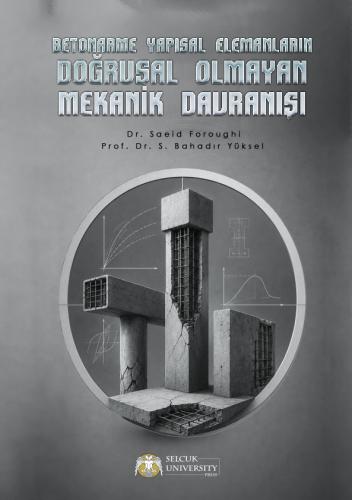
Nonlinear Mechanical Behavior of Reinforced Concrete Structural Elements
Synopsis
This study comprehensively addresses the theoretical and practical dimensions of nonlinear mechanical behavior in order to provide a more realistic and reliable assessment of the behavior of reinforced concrete structural elements under seismic effects. Nonlinear mechanisms such as cracking, plasticization, stiffness loss, and damage accumulation exhibited by reinforced concrete structures beyond their elastic limits form the basis of the performance-based seismic engineering approach. In this context, the study aims to evaluate the behavior of reinforced concrete elements not only based on strength but also through performance criteria such as deformation, ductility, and energy dissipation capacity.
Within the scope of the book, stress-strain models for concrete and reinforcing steel are examined in detail; the behavior of unconfined and confined concrete is evaluated comparatively using the Hognestad, Mander, and Saatçioğlu approaches. The effects of these material models on the behavior of reinforced concrete sections are analyzed through moment-curvature relationships and curvature ductility parameters.
This study systematically reveals the effects of axial load level, reinforcement ratio, confinement arrangement, and cross-sectional geometry on nonlinear behavior through comprehensive parametric analyses performed on square, rectangular, and circular cross-section columns, double-reinforced beams, and reinforced concrete shear walls. The findings demonstrate that the seismic performance of reinforced concrete elements is largely determined by the moment-curvature relationships and ductility capacity at the cross-sectional level.
One of the book's original contributions is a new analytical approach developed for determining the curvature ductility of reinforced concrete beams. This approach allows for a more consistent definition of ductility, directly integrable into engineering applications, by considering the process of cross-sectional behavior from the onset of damage to the failure limit state. Furthermore, the comparison of different confined concrete models under the same cross-sectional conditions clearly reveals the critical impact of model selection on structural performance evaluation.
In conclusion, this work offers significant theoretical and practical contributions to the field of performance-based seismic engineering by addressing the nonlinear mechanical behavior of reinforced concrete structural elements with a holistic approach at the material, cross-section, and element levels. The work serves as a comprehensive reference source for both academic research and engineering applications.
How to cite this book
License

This work is licensed under a Creative Commons Attribution-NonCommercial-ShareAlike 4.0 International License.
Published
ISBN
DOI
Categories
Copyright (c) 2026 Selcuk University Press